#35
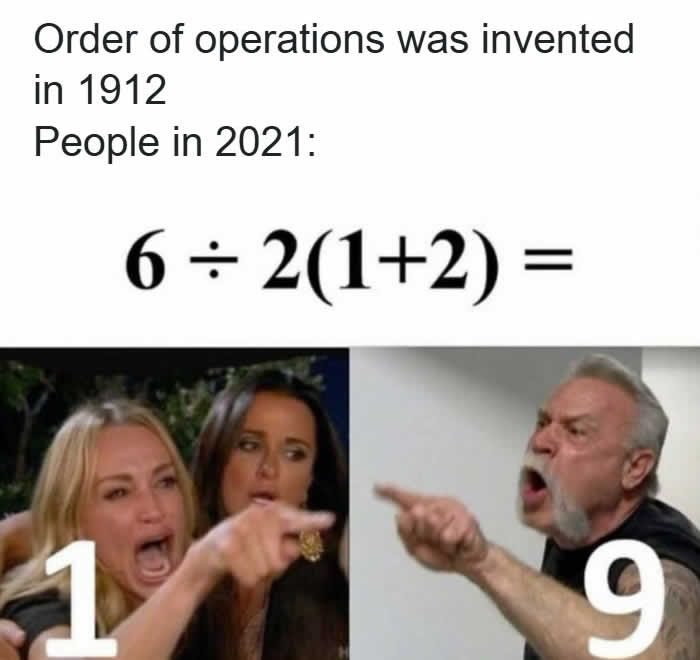
The order of operations for mathematical equations was formalized in 1912 to help standardize calculations and avoid confusion. Some of the most common rules include BODMAS or PEMDAS, which tell us the sequence in which operations should be performed. For this discussion, we’ll focus on the BODMAS rule.
BODMAS is an acronym that stands forBrackets, Order (i.e., powers and roots), Division, Multiplication, Addition, Subtraction. It’s designed to guide us through calculations step by step so that everyone arrives at the same answer.
Despite these clear rules, debates about certain equations still persist even today. Take the classic example:
6÷2(1+2)6 \div 2(1+2)
According to BODMAS, we solve the brackets first:1+2=31+2 = 3. Then, we perform division before multiplication:6÷2=36 \div 2 = 3, and finally multiply by 3, giving3×3=93 \times 3 = 9.
However, some people argue that the answer should be 1, depending on how they interpret the notation. This ongoing debate shows that even with standardized rules, math can still spark heated discussions!